Sunday, February 8, 2015

Budapest - part 2

photo by Richard Bogdán at Millenniumi emlékmű, Budapest
Millenniumi emlékmű (Millennium Monument) is to Andrássy Avenue as the Arc de Triumphe is to Champs-Élysées.
Museum of Fine Arts              Millennium Monument
Heroes' Square
Construction began in 1896 to commemorate 1,000 the year anniversaries of the 

Behind us in the photograph, there are statues of 14 men. The man, second from the far right, is Lajos Kossuth, a famous Hungarian lawyer, journalist, politician and Regent-President of the Kingdom of Hungary in 1848-49. He was well known in the United States and - Cleveland, Ohio as a champion of democracy. 


                              Budapest                                                  Washington, D.C.

David E Davis Sculpture Garden
Euclid Avenue between Chester & MLK
Cleveland, Ohio

Buda
Our first day we began our exploration of Budapest, starting with Buda, the oldest part of the city, which was settled after the withdrawal of the Mongol invaders in 1242. Climbing to the top of Gellert Hill, we experienced a spectacular view of the entire city.

photo by Richard Bogdán
Perched at the top of Gellert Hill is the famous Liberty Statute (referred to by the locals as the world’s largest bottle opener). 


Behind this stature lies a remarkable back-story. After World War I ended, the Treaty of Versailles was signed five years after the assassination of Archduke Franz Ferdinand, the heir presumptive to the Austro-Hungarian throne. Few would disagree that the harsh terms of the Treaty of Versailles contributed to the conditions that led to World War II. However, not just Germany was dealt with harshly. Hungary lost a large amount of land under the terms of the treaty.
    Miklós Horthy served as Regent of the Kingdon of Hungary between the World Wars. In the late 1930's, Horthy formed an alliance with Nazi Germany. With Hitler's support, Horthy was able to reclaim much of the Hungarian land lost after World War I. However, Horthy would neither contribute to the German war effort, nor participate in the deportation of Hungarian Jews, which ultimately led to the invasion of Hungary by Germany in March 1944.
   Early during the WW II effort, Miklós Horthy's son was killed in an aviation accident. A statue was commissioned in memory of Horthy's son, and the statue was begun but never completed. The statue was to become a figure, holding a broken propeller over his head while standing in the wreckage of the aircraft.
    Budapest was bombed by the allies at the start of WW II, and bombed by the Germans at the end of the war to destroy bridges and resources as a last stand against the Russian army that was advancing through Hungary toward Berlin. The Russians of course prevailed, and when the Russians "liberated" Hungary, they wanted a monument in Budapest to their "liberty" under Soviet style Communism. Thus, the Liberty Statue was transformed by the original sculptor from a figure holding a broken propeller to a woman (modeled after a Hungarian nurse) holding a palm frond to the sky. The aircraft wreckage disappeared from the plan.
     Interestingly, the statue does not face Budapest, but rather looks to the east toward its Soviet inspiration. After much struggle, Hungary did of course emerge from Soviet dominance. The Hungarians, an eminently practical people, did not take down the statue. Rather than removing the statue, the Hungarians decided to leave it where she stands to show the Russians what freedom really looks like.
    This back-story comes from Richard Bogdán, our Budapest guide and history buff.


Dohany Street Snyagogue


The Dohany street Synagogue was built in the middle of the 19th century in Romantic style for the 30,000 members of the Jewish community of Pest. The onion domes are strikingly Oriental-Byzantine, as is the face; the patterns in the brickwork were inspired by ancient ruins in the Middle East. It was a architectural novelty in its day with some Christian touches like a pulpit and large organ.  
    The Jews of Budapest were largely assimilated and were well represented in the mercantile and professional  classes of the city. For that reason, the Hungarians, although allies with Germany in WWII, were reluctant to comply with Hitler’s orders to deport its Jewish citizens. However, when Hungary tried to exit the war after the writing was on the wall, a pro-Nazi government took over and in only 52 days with only 19 Nazi soldiers, they were able to deport about 600,000 Hungarian Jews, mostly from the countryside where the Orthodox Jews resided. Because the Nazis ran out of time, most of the Jews of Budapest were spared Auschwitz.
     The synagogue was spared as well.  As the tallest structure in Budapest, Nazis antennaes had been placed on the top of the domes and the Nazis headquartered themselves in the building.


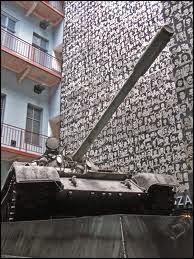
The House of Terror Museum


This was the most reviled building in Budapest during the mid 20th century. Converted to a museum, the House of Terror opened in 2002 amidst controversy. It is intended as a monument to the memory of those held captive, tortured and killed in this very building under the Arrow Cross Party (the Hungarian Nazi Party) between 1937-1945, and between 1945 and 1956 under the Stalinist-inspired AVO and its successor the AVH.
     The criticism is that it touches very lightly on the Nazis-era (one room) with numerous rooms dedicated to the abuses of the Stalinist Hungarian Communist Party. The museum opened shortly before an important national election to bolster the conservative right re-election. Fair or unfair, the museum serves as a powerful reminder of the barbarity and sadism of both the Nazis and the Communists. 
     At one point, we found ourselves packed into an elevator creeping lower into the depths of hell seemingly for eternity, trapped facing a video of a survivor describing in excruciating detail the methodology of executions performed in the basement dungeon. These two chapters of atrocity by the Nazis and subsequently by the Soviets are well captured by the design of the museum, assuring that the memory will not be lost by the Hungarian people or by the world.


_____________________________


On a lighter note, a section of Pest referred to as Elizabeth City is undergoing tremendous renovation. This building on Kazinzy Street (now becoming Culture Street) was saved from destruction.

We stepped through that door, and this video shows what we found on the other side.


Saturday, February 7, 2015

First stop - Budapest

photo by Richard Bogdán
taken from the site of the "Statue of Liberty"
The Danube and the Pest side of Budapest in the background


Our plan here in Europe included touring Central Europe. We have begun our trip in Budapest. Our AirFrance flight from Paris was uneventful as was our ride to downtown Budapest, and to one of the most beautiful hotels we have ever seen.

Budapest is the capital of Hungary with a population of two million people.  The city is divided into two parts, separated by the Danube River, the hilly Buda side to the west, and the sprawling flat Pest area to the east. 

Brief history

Unlike US history which dates back about three hundred years, the story of Hungary begins in Roman times. The country has experienced many setbacks starting with the Mongol invasion during the 13th century by two grandsons of Genghis Khan that wiped out over half of the population, an occupation by the Turks, absorption into the Hapsburg dynasty, and of course two world wars during the 20th century.  At its heights, Hungary’s borders touched three seas—the Baltic to the north, the Black to the east, and the Adriatic to the south. Today, Hungary occupies a tiny fraction of that land and is land-locked.

Our stay at the Four Seasons Budapest was orchestrated by Deedee, my step-sister and travel agent supreme.


Completed in 1906, and completely renovated in 2004, it represents a fine example of Art Nouveau architecture. Originally, it was home to the London based Gresham Life Assurance Company and called the Gresham Palace.  Being off-season and referred by Deedee who frequently books clients at this property, we were upgraded to a remarkable room with a remarkable view of the Danube River.

view from our balcony


The lobby was a great mix of old-world elegance, with subdued modern touches. The chandelier at first looks like a piece by Dale Chihuly. It was actually made by glass artists from the Czech Republic.


Tuesday, January 27, 2015

Croissant SUCCESS!!

You may recall from our prior post that our croissant project did not go quite as well when we tried it at home. We are pleased to report that we have found success! The biggest problem we had on our initial attempt was failure to properly activate the yeast. We solved the problem by proofing the yeast.


Sunday, January 25, 2015

Palais Garnier - The Paris Opera House


When guests arrive in Paris, we often meet them across from the Palais Garnier where the Roissy bus drops off passengers from Charles de Gaulle Airport. Coming out of the Opéra metro station, I am dazzled by the sight of the Palais Garnier as I come into the light.

The Paris Opera House, aka Palais Garnier, was built during the Second Empire under Napoleon III. A young architect named Charles Garnier was chosen through a competition. The opening of the grand opera house was meant to coincide with the 1867 Universal Exposition, but in fact it was not completed until 1875. By that time, Napoleon III was long gone following the disastrous defeat of the Franco-Prussian War and the project so far over budget that poor Garnier was not invited to the grand opening.

Considered a masterpiece by many, this apogee of Beaux Arts architecture has been criticized as an over-the-top temple to the rich and socially connected. 

                    The Ballroom                                         The Grand Stairway

Marc Chagall ceiling
Inside the auditorium
(Photographs courtesy of Alex Peacocke)
. 


In reality, most of the theatre of the Palais Garnier took place off stage.  The opera house was purposefully designed to showcase the patrons rather than the players--to flaunt and to dazzle.  Here, on the grand stairway, inside plush box seats and afterwards in the ballroom, Parisian high society came to see and be seen. 

The infamous chandelier
The Paris Opera House is probably most famous as the setting for Gaston Leroux’s 1910 novel The Phantom of the Opera and the hugely successful Andrew Lloyd Weber musical, still playing on Broadway. How historically accurate is the story? In 1896, during a performance of Faust, the 8-ton chandelier broke loose, killing a woman in the audience and inspiring the novel. The foundation of the Opera House straddles an underground lake, which becomes the phantom's imaginary haunt in the story.
A new opera house was built under Mitterand in 1980’s “for the people".  It was pointedly built in the Place de la Bastille to emphasize the message. No doubt it functions much better as a venue for opera, music and dance, but in my opinion, it lacks the grandeur and pizazz of the Palais Garnier.

The new Opera House at Basteille


Saturday, January 24, 2015

Croissant!


Several days ago, Jessica and I took a cooking class at la cuisine paris. We were determined to learn how to make the genuine article - those flaky oh so good pastries that melt in your mouth, not the ones that look like a croissant but taste like wonder bread.

la cuisine paris
The school teaches a variety of French cooking techniques and classes are conducted in English. Judi gave Jessica a gift certificate to the school for her birthday, so off we went!

Like most baking, the elapsed time from raw ingredients to finished croissants greatly exceeds the actual amount of time spent making the croissant. Therefore, some steps were done out of order and pre-prepared. That way, the six hour refrigeration and the three hours to rise could be accommodated in a three hour cooking class.

The first step to make a croissant is to make the dough from flour, sugar, butter, salt, water and yeast. Once properly mixed, the kneading began.


Once kneading was completed, the dough was rolled into a ball, refrigerated, and we were presented with balls of dough made the day before that had been refrigerated overnight. We were ready to begin the critical stage, the tourage or laminating. This involves rolling a little over a stick of high quality unsalted butter into a thin sheet nearly the size of a sheet of looseleaf paper. The dough is rolled into a slightly larger sheet and the butter is placed on the dough. A series of folds and rolls ensues until there are in theory, 60 layers of dough and butter within a rectangle about the size and thickness of a mouse pad.


The sheet is cut into long triangles. The dough triangles are rolled into croissants, and then they are allowed to rise for a couple hours - and into the oven - et voilà! - or not. When we tried it at home, we ended up with a cross between croissant and matzah (croizzah?).


It was an issue with the yeast. I think we will get it right next time - stay tuned!


Tuesday, January 13, 2015

JE SUIS CHARLIE (I am Charlie)

During the past week, we have heard from many of you about the horrific events that were taking place in Paris - the murders of cartoonists and journalists at the offices of Charlie Hebdo, the killing of three police officers, and the death of four Jewish hostages at a kosher market. We felt humbled to the be the guests of a city and a nation reeling in pain from the recent events. The mood in Paris is heartbroken and defiant. At no time have we felt personally threatened in any way.

Here is a chronology of events:

Wednesday, 7-Jan, 2015, 11:20 AM:  Said and Chérif Kouachi storm the Paris offices of the satirical magazine, Charlie Hebdo. The French-Algerian brothers kill eight journalists, a caretaker, bodyguard, and a visitor. They return to their car and exchange fire with police blocking their escape route. They kill an injured police officer, execution style as they escape.

Wednesday afternoon:  The Kouachi brothers abandon the car and hijack another to make their escape from Paris.

Thursday, 8-Jan, 2015, 10 AM:  The Kouachi brothers hold up a gas station at gunpoint in the town of Villers Cotteret, about 10 km from the Charles De Gaulle airport. Thousands of security personnel are deployed in the area. Two runways are shut down at CDG.

Later Thursday, the news emerges that a policewoman has been shot and killed.

Friday 9-Jan, 2015, morning:  The Kouachi brothers hijack a third car. Police chase them to a printing works facility in an industrial complex near the airport. They have taken a hostage.

Friday, 9-Jan, 2015, noon:  Our daughter Laura was scheduled to land at Charles De Gaulle.

Friday, 9-Jan, 2015, 12:27 PM:  Laura lands after circling for 25 minutes.

Friday 9-Jan, 2015, 12:30 PM: A third gunman named Amedy Coulibaly has taken a hostage at a Jewish supermarket, takes four more hostages, and kills two. Coulibaly is linked to the killing of the policewoman. Coulibaly tells negotiators that he will kill his remaining hostages if police launch an assault on the Kouachi brothers.

Later Friday, special forces kill the Kouachi brothers and free the hostage. Coulibaly is killed, and four hostages die.
____________________________________

So is this France's 9/11? No, but the pain was real and the visceral reaction of the French was intense. On Thursday noon, a moment of silence was called by French President Hollande, and everything came to a halt - everything. At 6 PM, the lights of the Eiffel Tower went out for 5 minutes.

On Sunday 11-January, a demonstration in Paris gathered. Although there were 40 heads of state present, they remained silent - no speeches. This was an opportunity for the people to speak out, and they did. Estimates of the number of people gathering in Paris ranged from 1 to 1.5 million. Some said it was the biggest public gathering in France since the liberation of Paris in August 1944. Imagine everyone in Cleveland Ohio AND surrounding Cuyahoga County - everyone - arriving at one location to show their solidarity. The Paris metro was free. All major faiths and numerous nationalities were represented. Police were cheered. There was no violence.

Place de la République, 11-January, 2015

We were there - sort of. We could only get within 1 km of République because of the vast number of people. Here are some pictures I took.

mob scene at the metro


Liberté

looking back from where we stood


Thursday, January 8, 2015

Cabaret au Lapin Agile

Le Lapin Agile, painting by Raphaël Toussaint


painting by André Gill
Last Sunday, we spent an evening out on the hill of Montmartre with friends from out-of-town. After dinner, we paid a memorable visit to the Cabaret au Lapin Agile.

Perhaps the most famous cabaret in the world, it came by it's name in a strange, random way. The Cabaret had been around since the 1850's and had been called the Cabaret des Assassins until 1875 when André Gill painted the illustration of the rabbit jumping out of a sauce pan. The painting was placed outside the Cabaret and became its insignia. The Cabaret came to be called Le Lapin à Gill after the painter, and later morphed into the play on words Lapin Agile.


There is a long, storied history of the many visitors to Lapin Agile during the past 150 years. Over 100 years ago, it was a popular hangout for artists including Picasso, Modigliani, Apollinaire and Utrillo. The Cabaret was and remains located at the heart of artistic Paris on a narrow cobblestone street and situated on the hill of Montmartre.

painting by Pablo Picasso, Au Lapin Agile
Early in the 20th century, Fréderic Gérard (aka Frédé) took over the operation of Lapin Agile. He knew his clientele well, and would often accept paintings in exchange for drinks. This painting Au Lapin Agile done by Pablo Picasso in 1905 was part of such a settlement with Frédé, who is depicted in the background playing his guitar. In the foreground are Picasso himself and his lover. It hung in the Cabaret until 1912 when Frédé was forced to sell it - for about $20. It later sold for $41 million in 1989, and I believe currently is located in the Metropolitan Museum in New York. A replica now hangs inside the Cabaret.


Le soleil se coucha sur l'Adriatique
(Sunset Over the Adriatic)
   So what happens when some of the most creative minds in Europe hang out and drink together at the Lapin Agile? Here is but one example:
   Frédé kept a donkey named Aliboron (shortened to Lolo), who was a favorite in the neighborhood. In response to a new wave of artwork becoming popular at the time, a paint brush was tied to Lolo's tail, and Le soleil se couch sur l'Adriatique was created at the front door of the Lapin Agile. The artist was billed as Joachim Raphaël Boronali. Please note that "Boronali" is "Aliboron", slightly rearranged. Exhibited and then written up by the Salon des Indépendants, the painting received high praise, described as the first of the new "Excessivism Movement". The painting sold for 400 Francs before its true origins were revealed. For the full story, go here.

Frédé and Lolo
So off we went! I was surprised how little the place resembled a Cabaret from the outside. However, inside it was dark, funky bar and night club! The entertainment was musical, and all in French. However, it was not hard to get the gist of much of the humor. And there, behind the piano player, hung the Picasso, with the whole scene looking much as it did in 1905.

We were amongst the early arrivals at 9 PM. The Cabaret began to fill up as the pianist played wonderful jazz in the background. As the place filled up, some members of the audience were getting into it and singing along with the  pianist. The transition took a few minutes, but eventually it became clear that this segment of the audience was the entertainment as the sing alongs became full-throated performances. They were just wonderful! Most memorable to us was the animated performance of Fais Moi Mal Johnny written by Boris Vian - the story of a young lady looking for a hot time who gets more than she bargained for.