Monday, March 2, 2015

The Berlin Wall

         from the west side of the Berlin wall showing the constantly patrolled no-man's land to the east

After World War II, Germany was divided into four occupation zones, each controlled by one of the four major allied powers which were the United States, the United Kingdom, France, and the Soviet Union. Germany's capital Berlin was located near the eastern border of Germany and therefore was well within the Soviet occupation zone. Berlin was divided into four occupation zones as well.

Within a few years, the US, UK and French zones were merged as German reconstruction proceeded. However, East Germany remained under Soviet control and became part of the eastern bloc of Soviet dominated satellite states.
    The three zones controlled by Allied powers in Berlin were merged as well, forming West Berlin (the small grey dot in East Germany on the map to the left) . East Berlin remained separate, and under control by the Soviet Union.

    Initially, there was no border between east and west Germany, but that changed as East Germany became more firmly established as part of the Soviet Bloc. In 1948, Joseph Stalin instituted the Berlin Blockade, disrupting the flow of food and supplies through East Germany to West Berlin by rail. This was countered by the Berlin Airlift of 1948-49. When the unsuccessful blockade was lifted in 1949, more materials were coming to West Berlin by air than had been previously coming by rail. In all, over 200,000 airlift flights were flown.

The border between East and West Berlin was the most porous for those who wished to flee Soviet life. Subways still ran in the city. Many lived in the east and worked in the west since most of the jobs were in West Berlin. A huge exodus and brain drain from the Soviet Union was occurring in Berlin. Once in West Berlin, those who wished to leave Germany or travel to West Germany could do so. By 1961, 3.5 million, or 20% of the East German population had fled to West Germany and beyond.
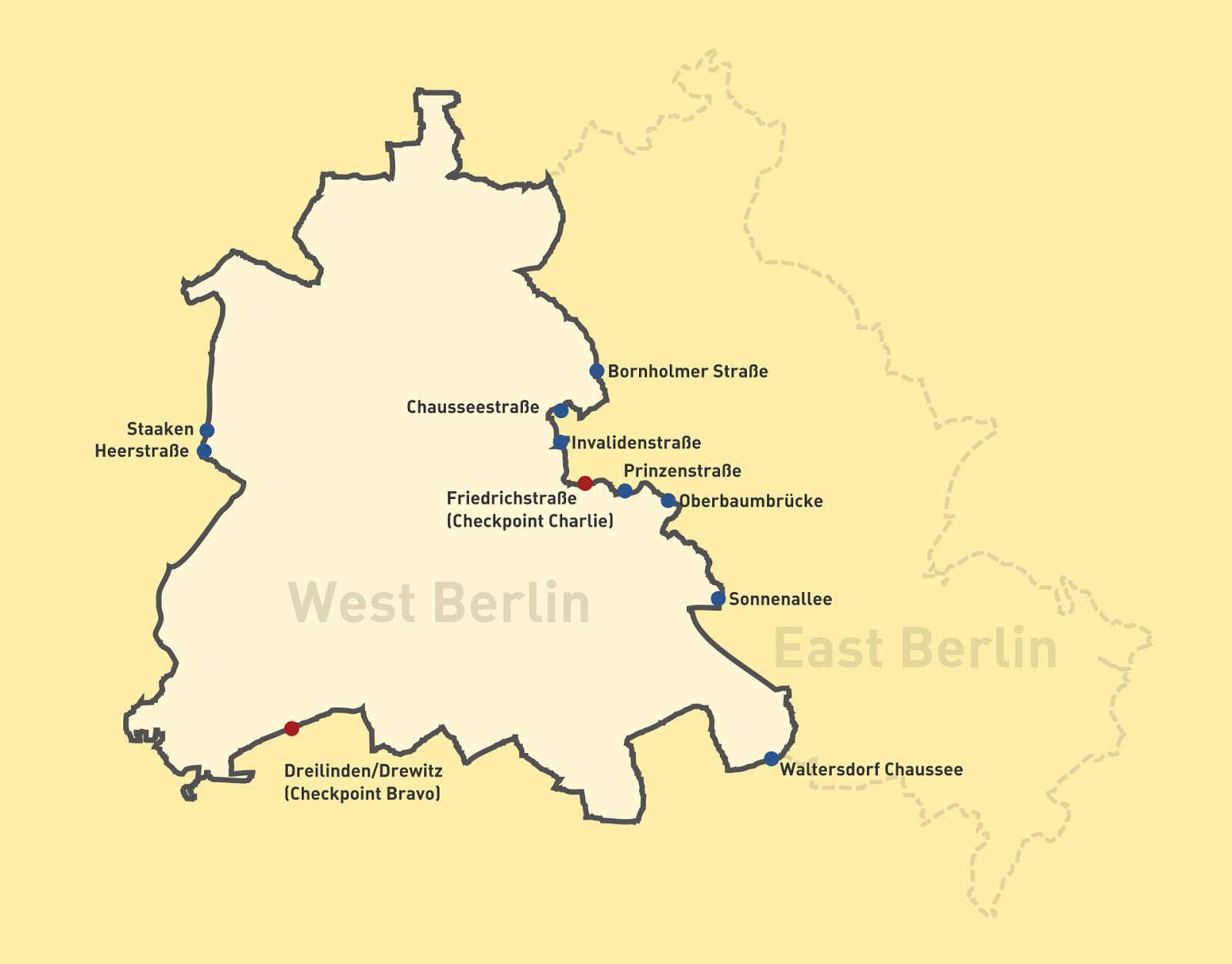
Immediately after midnight, Sunday morning 13-August 1961, the border to West Berlin was sealed without warning. Families were split. East Berliners could not get to their jobs if they worked in the west. The easiest place to emigrate to the west suddenly became the hardest. The wall started as a highly patrolled wire fence, with actual construction of a concrete wall beginning in 1965. A wall between East and West Berlin was insufficient. The wall had to completely surround West Berlin.

In its final form from 1975 to 1989, the 96 mile long wall consisted of 45,000 sections of reinforced concrete, each about 12 feet high. Barriers were set up about 100 meters outside the wall creating a "death strip". Intruders were shot.
     Adjacent to the "death strip", watch towers were spaced every few hundred meters and bright lights were on all the time. There were mine fields, dogs, and numerous other unpleasantries that made crossing virtually impossible.

Any structure in the path of the death strip
was doomed, including The Church of Reconciliation
The clip shows the destruction of the church, and the Chapel of Reconciliation at the site today.

Nonetheless, people tried, and people died. The death toll is estimated to be at least 200, probably much higher. About 5,000 East Germans did escape in remarkably creative ways. Digging underground tunnels, hot air and gas balloons, light aircraft, the sewer system, and abandoned subway tunnels were some of the chosen escape routes.

Presidents from the United States weighed in as well. On June 26, 1963, John F. Kennedy gave his famous "Ich bin ein Berliner" speech. On June 12, 1987, Ronald Reagan gave his famous "Mr. Gorbachev tear down that wall" speech at the Brandenburg Gate.

Bruce Springstein got into the act as well. As an aging Woodstock rocker, I could not be more proud of The Boss and his performance in East Berlin on July 19, 1988.
I am not for or against any government. I've come to play
Rock n' Roll for you in the hope that one day,
all barriers will be torn down.

The Berlin wall would come down one year later. The real, mostly unsung hero of the peaceful fall of the Berlin Wall was Mikhail Gorbachev and perestroika. The people, particularly the young people, brought the wall down, but many believe that Bruce Springsteen was a catalyst. In chemistry, a catalyst greatly speeds up a reaction that would have happened eventually. And so it was with The Boss. He was The Spark.

Things really began to fall apart on August 19, 1989. The border defenses between Hungary to the east and Austria to the west came down, and during the next month, more than 13,000 East Germans escaped to Austria through Hungary. Attempts to stop the exodus through Hungary resulted in similar actions in Czechoslovakia. At this point, the Peaceful Revolution was well underway on multiple fronts. On November 4, 1989, 500,000 people demonstrated in Berlin. On November 9, 1989 the Berlin wall was no longer a barrier between east and west. The checkpoints were opened.


Checkpoint Charlie

Checkpoint Charlie is a major tourist attraction. Berliners call it Checkpoint Disneyland. Today, the guard house is a replica (the original is at the Allied Museum). The guards are replicas, actually actors who demand to be paid if they are included in pictures. Folks are running around hawking trinkets and picking pockets.

The name Charlie was simply the third letter of the phonetic alphabet, after alpha and bravo. This became the site of a standoff which was the culmination of the Berlin Crisis of 1961. As early as 1958, Soviet Premier Nikita Khrushchev issued an ultimatum that western powers withdraw from Berlin. Western powers said no. The ultimatum was withdrawn in 1959 in favor of searching out a political solution. However, all discussion between Khrushchev and President Eisenhower ended when Gary Powers was shot down over the Soviet Union while flying the U-2 spy plane.

Emigration from east to west through Berlin had risen to the level of a crisis for the Soviet Bloc. By early 1961, the Soviets were convinced that only force would stop the mass emigration. However, prior treaty specified that there would be free travel within the sectors of Berlin. Despite this, the wall went up in August 1961, but allied authorities were allowed access to all sectors of the city as specified by the Potsdam Conference of 1945.

Two months after construction of the wall, on October 22, 1961, US Chief of Mission, E. Allan Lightner was stopped at Checkpoint Charlie while attempting to cross into East Berlin. Although the occasional tank had been close to the checkpoint, the confrontation escalated at this point, and 33 Soviet tanks arrived at the Brandenburg Gate, 10 of which proceeded to Checkpoint Charlie. This was met by equal force on the Allied side of the checkpoint. Both groups of tanks were loaded with live munitions, and both sides had orders to fire if fired upon. They were less than 200 meters apart.

Kennedy and Khrushchev negotiated indirectly by telephones through their representatives on the ground in Berlin. The agreement reached was that the Soviets would back off initially 5 meters, matched by a similar allied response. Ultimately the situation was defused. In return, Kennedy apparently agreed to take no military action against the wall.

Checkpoint Charlie, allied side 1963
Checkpoint Charlie, Soviet side 1982
Replicated Checkpoint Charlie today with actors

Buildings at Checkpoint Charlie
Kaffee Einstein is one the right, ground floor

Interesting historical note:  Legend has it that John le Carré wrote The spy Who Came in From the Cold while looking out at the Berlin Wall from his seat at the Café Adler. Café Adler has since closed, but Kaffee Einstein presently occupies the same space.

Tuesday, February 24, 2015

Berlin

The dome of the Reichstag
as seen from inside the Berlin Hauptbahnhof (train station) 
After World War II, our parents would never have considered visiting Germany. They were not able to reconcile their revulsion toward the Third Reich with the new Germany that subsequently emerged. Nor did they give significant thought to the suffering that took place for decades under the oppressive Communist regime of East Germany.
     Nearly a lifetime has passed since the end of the war. Seventy years later, we came to Berlin to see for ourselves the changes that have taken place in a city that is willing to confront its past. What we saw was fascinating and affirming.


Ordinary citizen sitting on a bench
observing but not reacting to extraordinary times
(Jews were forbidden to sit on public benches during the Nazi era)

This statue is part of the larger memorial called Block der Frauen by Ingeborg Hunzinger.


Bebelplatz Public Square


On the 10th of May 1933, Opernplatz (now named Bebelplatz) became the most famous of the many sites of public book burnings. Invited that day by the German Student Association, Propaganda Minister Joseph Goebbels gave a fiery speech condemning "un-German" literature. The events were accompanied by torchlight parades, marching bands, ritualized ceremonies, and bonfires of burning books. An estimated 20,000 books were burned that night. Amongst the authors were
German authors: Heinrich Heine, Karl Marx, Albert Einstein, Bertolt Brecht, Sigmund Freud, Franz Kafka, Joseph Roth, Franz  Werfel, Stefan Zweig.
Non-German authors: Victor Hugo, Ernest Hemingway, Helen Keller, Joseph Conrad, D.H. Lawrence, H.G. Wells, Aldous Huxley, James Joyce, Fyodor Dostoyevsky, Vladimir Nabokov and Leo Tolstoy.


10-May, 1933

Today, the memorial by Micha Ullman consists of a glass plate set into the cobblestones of the square, providing a window which looks down into empty bookcases. The plaque translates, “Where they burn books, they will in the end also burn people.”  Heinreich Heine (1821)
Bebelplatz Public Square

Mutter mit totem Sohn, Käthe Kollwitz


Neue Wache, is a historical building which has served as a war memorial for different purposes in different times. Today, it stands as a memorial to all who have died in war and tyranny. It contains a single statue — an enlarged version of Käthe Kollwitz’s pietà-style sculpture Mother with her Dead Son with an opening in the rooftop allowing rain and snow to fall on the sculpture.

The backstory is poignant.  During World War I when patriotism was at its highest intensity, Kollwitz’s son wanted to fight as a soldier. Because he was only 17-years-old, he needed permission from a parent. His father, a minister, refused permission. Käthe, seeing her son's determination, finally agreed to sign. Two weeks later, their son was dead. Kollwitz never forgave herself or got over the loss.

Neue Wache


Holocaust Memorial - Denkmal für die ermordeten Juden Europas


     After many years of debate, the German Parliament decided to build the memorial to honor the memory of the six million Jews who were murdered by the Nazis. The memorial finally opened in May of 2005. Located right next to Brandenburg Gate, the memorial to the murdered Jews of Europe keeps the memory of an unimaginable part of German history alive.
The experience consists of an abstract sculpture garden made up of 2,711 (a prime number) concrete slabs. There is no goal, no end or beginning, no particular way in or out. The memorial was designed by New York architect Peter Eisenman. Your response to this memorial is emotional, not intellectual. Strange.

Holocaust Memorial aerial view


On day two, we went on separate museum tours. I went to the large and highly regarded technology museum. During both my professional life and my leisure time, I have had considerable exposure to technology mostly from an American perspective. The trip through the last 150 years of parallel German advances provided interesting contrast. The similarities are far greater than the differences.

As was the case throughout Berlin, there was no attempt to hide or gloss over the Nazi regime or the war effort in which new technology played such an important role. As was the case elsewhere in the city, the displays frequently went a step further to remind the exhibit viewers of the magnitude of propaganda, and the way that ordinary people were swept up by the nationalism and the war effort. This included the showing of propaganda newsreels, and recent interviews of both German workers and former prisoners of war who worked together in aircraft and missile factories.

I got to visit technology that constituted a significant part of my childhood hobby days including ham radio equipment built by German teenagers. When I was a teenager, I built similar equipment. 

In the photograph above, a German study guide for Morse code with the insignia for the DARC (Deutscher Amateur-Radio Club) can be seen behind the equipment. I was a member of the ARRL (American Radio Relay League), the American equivalent to the DARC.

 I got to see early computer technology from the days when my father, and later when I worked as a computer programmer. I was 12 or so when my dad explained to me how newly developed state-of-the-art computer memory worked. The memory was called core. Each binary digit (0 or 1) was stored on a magnetized circular core measuring about 1 mm. It was a marvel of miniaturization. The tiny cores were hand-wired in square arrays typically 16x16 or 256 cores. Since one Byte usually consists of 8 bits (binary digit), one of these square arrays about the size of a big postage stamp could store 32 Bytes or alphanumeric characters. It was a miracle of modern technology and miniaturization. I knew how they worked. I knew what they looked like. However, I never actually saw one until my visit to the Berlin Technology Museum.

4 core arrays, hand wired and soldered in place


close up view
As computers advanced from the 1950’s to the 1960’s, this new technology allowed computers to manipulate tens of thousands of Bytes at a time, a huge advance. Of course, that would require a thousand or so of the hand-wired postage-stamp size core arrays that cost hundreds of dollars each to make. The museum displays more recent technological advances of computers and memory. The advances of course are staggering. Consider a smart phone today with 16 Gbytes of memory, now considered low-end. That amount of memory back then would have covered a half mile square and cost something like 100 billion dollars.


16 Gbytes and 20 cent coin
Now, instead of covering a half mile square, the same amount of memory covers about half an inch square, and costs about $10 instead of $100 billion.


reflections of the Douglas C-47
The plane of the legendary "Rosinenbomber" ("raisin" [candy] bomber)


Colonel Gail S. "Hal" Halvorsen
aka Candy Bomber
The plane on display in front of the museum is the type flown by Colonel Halvorsen during the Berlin Airlift of 1948-1949. (see Berlin wall [coming soon]) He got the idea of dropping candy from his C-47 cargo plane after he gave candy to German kids through a fence at Tempelof airport in West Berlin.
   He told the kids his plan to drop candy, and they asked him how they would know which plane was his. He said he would wiggle his wings. Thus he acquired the nickname amongst Berliners of Onkel Wackelflügel or "Uncle Wiggly Wings".
    He asked friends to contribute candy to the cause. Small cloth parachutes were made so the kids would not get hurt. He thought he was in deep trouble when he got called into the commanding officer's office. Instead, he was congratulated and the program was expanded. Ultimately, 23 tons of candy were dropped over various places in Berlin.


The aviation portion of the museum is housed in a new, large building. Extensive histories of both commercial and military aviation were presented. 
earliest aviation
early Lufthansa


later Lufthansa
World War I


World War I


World War II


World War II jet
V2 rocket - wind tunnel model


V2 rocket model - wind tunnel testing
V2 rocket viewed from the top down


Alte Nationalgaleria

Jessica visited Alte Nationalgaleria (The National Gallery) to view the collection of 19th century German painters. This is some of what she saw:

Caspar David Friedrich


Lone Tree, Casper David Friedrich (1822)


Caspar David Friedrich’s masterpiece Lone Tree is considered an allegory of German history in the early 19th Century. The weathered oak serves as a metaphor for the rigors and hardships suffered by Germany. While battered at the top, the tree still stands and new growths emerge.


Karl Friedrich Schinkel


Medieval City on a River, Karl Friedrich Schinkel (1815)


Aldolf Friedrich Erdmann von Menzel


Flute Concert with Frederick the Great in Sanssouci, Aldolf Friedrich Erdmann von Menzel (1852)


Iron Rolling Mill, 1875 Aldof Friedrich Erdmann von Menzel


Max Liebermann


The Flax Barn at Laren, Max Liebermann (1887) 
Max Liebermann (1847- 1935) was a German-Jewish painter who was the leading proponent of Impressionism in Germany.  His un-romanticized paintings of working class shoemakers, peasants, orphans, goose pluckers and netmenders were considered unsuitable subjects by his critics.


Otto Weidt, Workshop for the Blind


Otto Weidt was a German brush manufacturer who during the Second World War employed mainly blind and deaf Jews. Otto Weidt’s efforts the protect his Jewish employees from persecution and deportation saved lives. As danger grew, Otto Weidt searched for hiding-places for some of his employees.  One of these hideouts was in a hidden back room which is now part of the museum.  Unfortunately, the location was revealed by an undercover collaborator.  The workshop, now a museum, is maintained by the German Resistance Memorial Center Foundation.


Workshop employees