Thursday, December 11, 2014

Lyon, Fêtes des Lumières 2014

Festival of Lights
The Lyon Festival of Lights has its origins back in 1643 when Lyon was struck by the bubonic plague. Everyone lit a candle and placed it on the windowsill. This later evolved into an annual tradition on the 8th of December and has progressed to a four day festival that attracts four million visitors annually.

Lyon is the third largest city in France, situated at the confluence of the Rhône and Saône Rivers about 290 miles south of Paris. Since it is only a 2 hour high speed train ride, Jessica, Erica and I decided to make it a day trip.


We had three reasons to go to Lyon:
  1. For the Festival
  2. For the Lumière Museum
  3. For the food
First, the food:  Some consider Lyon to be the food capital of the world. Certainly, it is the culinary capital of France. So we made sure that we were hungry when we got off the train early afternoon. But, according to Alexander Lobrano, author of Hungry for France, skip the starred Michelin restaurants and head for a simple bouchon where the locals eat. 

Bouchon, the French word for cork, is the name given to the simple, hole-in-the-wall places that serve hearty, "head-to-tail" Lyonnais soul food. A bouchon recommended by Lobrano was also featured on Anthony Bourdain’s Parts Unknown show. So that is where we headed: Café Comptoir Abel. We were not disappointed.

Poulet aux morilles à la crème
Bresse chicken
cream sauce
Morel mushrooms

Saucisson lentilles
Sausage with lentils

Quenelles de brochette
fluffy bone pike dumplings
(sophisticated version of Gefilte fish)

Our next visit was to the Lumière Museum. The Lumière brothers were brilliant inventors and shrewd businessmen. Along with Thomas Edison's role in developing the cinema, and George Eastman of Kodak fame, all these men were quite busy with their respective contributions to the film and cinema industries in the last decade of the 19th century.

The Lumière brothers, Louis and Auguste, were raised in Lyon. Their father, who ran a small portrait painting and photography studio, challenged his sons to develop a better film. Louis succeeded, creating the first dry film plate with silver bromide emulsion. When their father retired in 1892, they took over the business. It was at that point that the business expanded and cinematography projection was born.

Today, the museum displays some of the brothers' many inventions and devices, and numerous old movies are available for viewing. The museum is housed in the original art nouveau style Lumière mansion in Lyon.

musée Lumière


The Festival
As night began to fall, we left the museum and took the métro back to the center of town. There were 75 separate light shows scattered throughout the old-town and surrounding sections of Lyon.

For a You Tube synopsis of the 2013 festival, please check out this link and check out this detailed description.

This is an example of the many shows to be seen each night of the festival, this particular one at the Place des Terreaux.

Here are some of the photos and videos I took. (The videos are invisible on most phones and pads.)


Saône River reflections

We left Lyon on the 9:00 pm train. We were in our beds 300 miles away in Paris before midnight, thanks to the superb public transportation in Lyon, Paris, and in between.

parting shot from the train station

Tuesday, December 9, 2014

An American In Paris (scalped edition)


We waited too long. The ads were everywhere on the kiosks and at métro stations.

Malheursement, when An American in Paris finally opened at the Châtelet Theatre in Paris, every performance was sold out.

Not ones to give up, Jessica and Erica decided to take their chances and show up for the Sunday matinée with the hope they would find someone selling extra tickets.  Eric, so certain of a bad outcome, would have no part of it.

Jessica and Erica showed up at 3:00 p.m., an hour before the performance, and Jessica held up a sign.


. . . no action for 50 minutes.  At last, a tall, somewhat sketchy looking man approached Jessica and offered to sell two tickets for 120€.  "I paid 140€," he claimed.

Jessica knew to be cautious and told the man to wait while she confirmed the authenticity of the tickets. Inside the theatre, two ushers told her the tickets were valid. They looked like good orchestra seats.  Happily, Jessica forked over the money.  Jessica and Erica entered the majestic theatre, ecstatic to have found good seats for a completely sold out performance!


Soon they discovered the problem - the view from their seats.


In reality, these were 8€ seats -- the dregs.  To see the show, they had to peer around a large post.

Did the experience of being scalped deter from their enjoyment of the performance of An American in Paris?  They considered themselves lucky to have gained entrance to a show they would otherwise have missed.  The voleur was happy because he had tricked some Americans into overpaying for tickets. Eric was happy that Jessica and Erica had lost just their sleeves, not their shirts.

Oh, the dancing!  Ah, the lush Gershwin score! Oy, the utterly improbable plot.  They loved every minute.
Robert Fairchild & Leanne Cope

For a taste of the original musical, check this out and enjoy.

Tuesday, December 2, 2014

Thanksgiving in Paris

Thanksgiving turkies
Thanksgiving is just an ordinary Thursday in Europe, so our Thanksgiving guests did not arrive until the end of the week. We celebrated Thanksgiving on Saturday, a beautiful and clear day, continuing what has been an exceptionally mild Autumn.

Our guests represented many nationalities.

photo by Eric
                From left to right are
  • James, from Ireland, an attorney working in Luxembourg
  • Emily,  our niece who teaches at an international school in London
  • Anne-Marie and her husband Gerard, who is a physician from Fountainbleu, France
  • Jessica
  • Erica, Jessica's sister
  • Julia, from Berlin,who is currently a graduate student in Nottingham, England
  • Cary, an American, who works for a women's rights organization in London
  • Chris, an English social worker
     What a wonderful time we had together! We talked about our work, our families, the differences between our cultures, history, politics. The conversation never lagged.

We served a traditional Thanksgiving menu with a lot of French twists:
  • Turkey cooked on a rotisserie at the Woodrow Wilson open market
  • Cornbread sausage stuffing made with French saucisse de porc
  • Cranberry chutney
  • Mashed potatoes made with beurre de Normandie
  • Sweet potatoes with Marshmallows
  • Brioche instead of American rolls
  • Green beans with scallops and creamed mushrooms
  • Pumpkin pie and tarte aux pommes
  • Ladurée macaroons and chocolats
  • Lots of wine and Calvados (apple liqueur)


After a fine meal, we set off to see the Christmas lights, crossing the Seine and walking to the Champs-Élysées. We returned home via the Champ-de-Mars, walking under the night-lit Eiffel Tower.
Arc de Triumph - top center
Eiffel Tower - lower center
"home" - lower right corner


Eiffel Tower photos by Emily

On Sunday, we reminisced over Thanksgivings past through old videos and wonderful stories of family members no longer with us. Through the magic of internet technology, we joined family members who could not get to Paris.

All too soon, the party was over, leaving us with delightful memories and lots of leftovers.

Sunday, November 23, 2014

Parc des Buttes-Chaumont

The late November weather in Paris is predictably rainy and gloomy.  A rare sunny day is a terrible thing to waste. With that in mind, Erica, Eric and I ventured out to the 19th arrondissement to visit the Parc des Buttes-Chaumont for une randonnée (hike).  

Parc des Buttes-Chaumont is named for the bare hill (chauve-mont) on which it was built.  Due to the chemical composition of the soil, the site was almost completely devoid of vegetation and the neighborhood had a sinister reputation.

photo Henri Le Secq, 1852

All of this changed when Baron Haussmann chose the site for a new pubic park in 1864.  With great effort, work was completed in three short years, a remarkable accomplishment. The park opened to acclaim in 1867 for the Paris Universal Exhibition. It has been a popular destination for Parisians ever since. It is most remarkable that this beautiful park, this nature reserve in the city, is a man made creation.


Parc des Buttes-Chaumont centers around an artificial lake, which surrounds a rocky island (Île de la Belvédère). The steep cliffs are formed out of an old gypsum quarry.


At the top of the mount is the Temple de la Sibylle, a smaller re-creation of the ancient Roman Temple of Vesta in Tivoli.

The island is connected by two bridges with the rest of the park.  We crossed the 63-meter-long suspension bridge designed by none other that Gustave Eiffel.


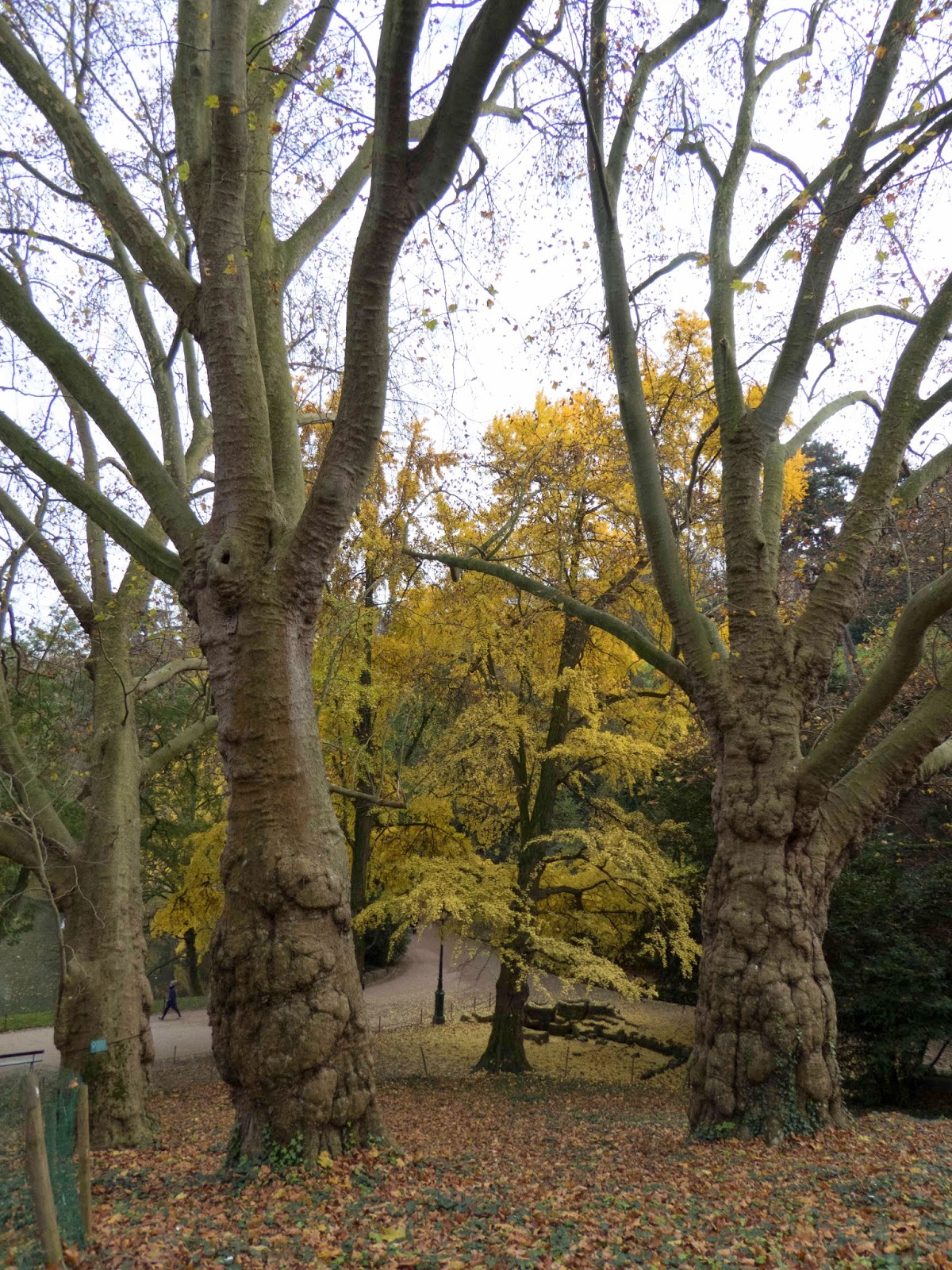
On the day we chose to visit the park, the fall foliage was at its peak and honey-colored afternoon sunlight filtered through the clouds. The temperature was brisk but not cold. Tourists were mostly absent. Amongst the many strollers we saw couples in love, families with young children, and contented older couples out for a walk.


After two hours, we returned home with our spirits renewed.   

Wednesday, November 19, 2014

The Bayeux Tapestry

This is actually an extension of the Normandy entries.  On our 3rd day in Normandy, we visited the city of Bayeux and the Tapestry depicting the events leading up to the Norman Conquest of England, the Battle of Hastings in 1066. The "Tapestry" which is actually embroidery, was made in the 1070's. It measures 70 meters (230 feet) in length, 50 cm (20 inches) wide. It's survival nearly intact is considered "little short of miraculous". Wikipedia has an excellent entry which can be found here.

The tapestry tells the story in pictures of scenes occurring from 1064 to 1066 of William, Duke of Normandy (William the Conqueror). It represents early "narrative art" intended for an audience that was mostly illiterate depicting the invasion. Bryan Talbot referred to the tapestry as "the first known British comic strip". There have been many knock-offs, including this New Yorker cover by Rea Irvin in 1944.

July 15, 1944
These are pictures I took of the tapestry. They do not begin to capture the story.


By clicking here, you are taken to a .jpg file in the Wikipedia web site that shows in detail the entire length of the tapestry. Try it!

Down the street from the museum housing the tapestry sits the Cathedral of Notre-Dame in Bayeux. The tapestry resided here for many centuries prior to finding its way to its new home in the museum built to house it.


There is one particular scene fairly early in the tapestry sequence of William and Harold on a quest. While on their quest, Harold is depicted rescuing two soldiers from the quicksand at Mont Saint Michel, seen here:


For more on Mont Saint Michel, see Normandy (part 4).


Sunday, November 16, 2014

Normandy (part 4)

Mont Saint Michel

Days 4-5:  The time had come to say goodbye to the Normandy Beaches. The memories will live on, as will a profound respect for our parents' generation, especially the soldiers who were a part of the effort. Now our plan was to visit Mont Saint Michel. But first, we headed south to the seaside town of Granville where we rejoined Erica and Larry and spent the night.


Granville is an exciting little town on the eastern shore of Mont-Saint-Michel Bay. We planned to head for Mont Saint Michel early the following morning before the crowds had accumulated. In the meantime, it was time for dinner, and what a dinner we had!  We all agreed that it was the best food we have eaten in France. The restaurant was La Citadelle which you can find here.

The following morning, we drove to Mont Saint Michel. The crowds were gathering (even in November at 10 AM), but it was still manageable.


Mont Saint Michel has mostly been a monastery since the 8th century. It is phenomenal both from an architectural and a geologic perspective. The building has been evolving for many centuries. It sits on a mostly stone island referred to as a mont (mount) with an average diameter of about 305 meters (1,000 feet), a height of 92 meters (302 feet), and is positioned about 1 km (0.6 mile) from shore. However, all of these numbers vary from moment to moment because the tidal range is amongst the most extreme of anywhere in the world. The variation from high tide to low tide is about 14 meters (46 feet). This creates an interesting natural barrier between the mont and the mainland. Many an unwary or reckless tourist has been lost thinking that there was plenty of time to cross by foot at low tide. If the onrushing tide did not get them, the quicksand did.

low tide
high tide

We did a lot of climbing to the top of the mont and beyond in the Monastery itself. Here are some of my pictures:


part of the maze of rooms                                               A winch of sorts.
                                                                                    Six men would get inside the wheel and walk.
                                                                                   That way, heavy loads could be lifted into the Monastery.

Black Madonna
Check out this interesting link.

After many hours of exploring, we traveled the 2 km back to the cars, drove the cars back to Rouen, walked back to the train station, and took the train back to Paris. A most extraordinary trip was had by all.