Thursday, April 12, 2018

Table Mountain


Panoramic view of Table Mountain (Wikipedia)


Panoramic view of Cape Town from Table Mountain (Wikipedia)

The first humans to stand in awe of Table Mountain did so tens of thousands of years ago. The first recorded ascent of Table Mountain by a European was by the Portuguese explorer António de Saldanha in 1503.

On the day we did our ascent, we had the benefit of a clear day and a cable car. The altitude of the mountain is 1,067 meters (about 3,500 feet), and is surrounded by steep cliffs. Here are some of my pictures:


In the distance, Robbin Island can be seen on the left.
Nelson Mandela was imprisoned here for 17 years.

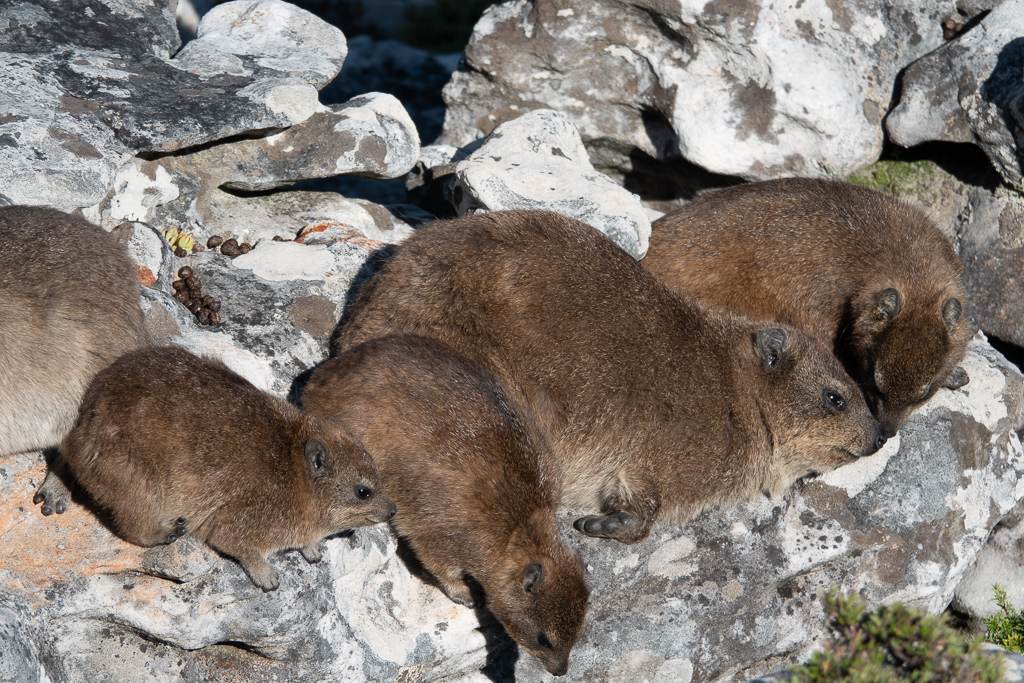
One of the more curious critters on Table Mountain is the Dassie. It has the appearance of a earless rabbit, but in fact it is not a rodent. It is a hoofed mammal, and it is the closest living relative to - the African Elephant!  


Lounging Table Mountain lizard (not to be confused with the Table Mountain Lounge Lizard).


Eric Erica Jessica Barbara


Cape Town, day 1

After clearing South African customs, our next task was to get to the Chartfield Guesthouse at Kalk Bay just outside of Cape Town. The rest of our mostly Cleveland Heights based group would join us later in the day. As discussed earlier, the trip has been organized by South African Journeys, created by Gus and Janet. Janet was born and raised in South Africa, and Gus lived there for many years.


View of Kalk Bay from the Chartfield Guesthouse (web site photo). The Harbour House Restaurant is one of the white buildings on the waterfront in the distance.


That evening, the three of us joined Mary, who lives in Cape Town at the Harbour House Restaurant for a wonderful seafood dinner. In an era long ago, Mary shared a flat with Paula, Jessica's close friend from Port Angeles.


Panoramic view of the dock, ocean, and mountains from Harbour House Restaurant, Kalk Bay.

In the dark after dinner, the wind picked up. Here are the sights and sounds of the restaurant and the sea.


Time Warp

What used to take months now takes 11 hours. For us, the sun set in London and rose the next morning in South Africa.


Our first African sunrise 7-April, 2018

Thursday, April 5, 2018

London

You know that you have arrived in England when a little Queen is waving to you from the neighbor's window.

The three of us are staying in a two bedroom flat in Putney, a three minute walk to our our niece Emily, her husband James, and the newest addition to the family, five month old baby Mae!

Our stay in London was mostly spent visiting Emily, James and Mae, and also our former German exchange student. Grischa stayed with us for several months back in 1996. How now lives in London with his wife Ayla and their three kids. It was great getting together with these wonderful people.


Jessica holding Mae, Emily, Grischa, Ayla in front, and their three kids.


Grischa and his son Batu


We did get to the British Museum. We spent most of our time exploring the African exhibit since we are heading that way soon.


Jessica partakes in her Afternoon Tea at the British Museum

Uneventful Travel

I never cease to be amazed that we can board a plane and travel from one continent to another in a matter of hours. My grandparents could remember a time before air travel. Now we can routinely travel nearly the speed of sound. 


Five hours after we left the east coast, we were approaching Ireland.


This is what the sky looked like at 41,000 feet on the dawn of a new day.


Saturday, March 31, 2018

Advancing Toward London

We departed from Cleveland today, now at Dulles Airport outside of Washington, D.C. with a six hour layover. Then we got lucky. We managed to sweet-talk our way into the United Global First Class Lounge even though we are not technically flying first class. 

Works for me. If you have to spend many hours in an airport, this is the way to do it.


Sunday, March 25, 2018

Why visit South Africa?

For all three of us (Eric, Jessica & and Jessica’s sister Erica) this will be our first visit to Africa.  Why South Africa?

For years we have heard about the incomparable beauty of South Africa. Our family friend Paula grew up in South Africa and spoke often of her love of the country of her birth. We met Paula’s father Derek, who had an apple farm outside of Cape Town, and we met other members of Paula’s family.  We learned how to make Paula’s family recipe for bobotie, the national dish of South Africa.

We read books about South Africa—Disgraced by JM Coetzee, Born A Crime by Trevor Noah, Collected Short Stories of Nadine Gordimer, My Long Walk to Freedom by Nelson Mandela, and The Covenant by James Michener.

South Africa has a unique history and culture. What we thought would never happen in our lifetimes — the end of apartheid — happened.  Like the rest of the world, we watched in amazement as Nelson Mandela, imprisoned for 27 years, 18 years on Robben Island, triumphed to become the first president of a post-apartheid South Africa in 1994 — this revolution occurring without bloodshed or a protracted civil war.  South Africa is a walking illustration of the power of a nonviolent movement.

All of these exposures to South African life cultivated our interest in this country. Still, a visit to South Africa would have remained on the back burner but for a small article in the HeightsObserver about group trips to South Africa organized by Cleveland Heights neighbors Jan and Gus Kious. This community-minded, civically active couple offered reasonably priced, 21-day small group trips to Jan’s home country twice a year with their mom and pop operation, South African Journeys.  Jan and Gus love South Africa and want to share this country with others. We signed up for the April trip.

 And so, the adventure begins, and the three of us partner again
 . . .
Jessica


Tuesday, March 20, 2018

Another 21 Months Later. Europe and South Africa 2018

Our travel blog lives! On the eve of Easter and April fools day, Eric, Jessica and Erica are again departing the USA for a great adventure. Jessica and I will be going to London for five nights to visit our wonderful five month old grand niece, the daughter of our niece Emily who is the daughter of Jessica's brother Corky and his wife Judi. Jessica's sister Erica will be traveling from Oakland CA to London to join us. Together, we will see the sights and visit with our former exchange student Grischa, his wife Ayla and their three children.

The three of us will then fly to Cape Town, South Africa and spend the next 20 days traveling around South Africa with the Kious family. Janet is a native of South Africa, and loves her country. Jessica and I will then fly from Johannesburg to Amsterdam where we will spend four nights before returning to the states at the end of April. Our travel maps out something like this.


Depending on access to good internet connections and having too much time on hand, I will do my level best to keep anyone who wishes to follow our travels up to date. Stay tuned!

Tuesday, August 2, 2016

One year later

This blog was originally created to document the adventures of Eric, Jessica and her sister Erica in Europe while we were living in Paris from September 2014 until June 2015. In June 2016, the adventure continued when Jessica and Erica returned to France to explore Brittany.

In late June and early July of 2016, my sister Erica and I explored the Emerald Coast of Brittany on a 9-day walking tour arranged by Headwater. Brittany (Bretagne in French) is a region in northwest France, west of the coast of Normandy. 


Brittany and Normandy viewed from the Space Station
Brittany has a distinct Celtic cultural identity with strong connections to the British Isles. Well before the Romans arrived, trading across the Channel thrived. Conquered by Julius Ceasar in 56 BC, the region became part of the Roman Empire. After the Romans withdrew, Celts from Britain moved into the area. Brittany became the battleground during the Hundred Years’ War between France and England. While still a duchy, Anne of Brittany married French kings Charles VIII and Louis XII of France. In 1532, Brittany finally became part of France.


Our trip got off to an abrupt halt with passport problems. Thanks to Eric's step-sister and travel agent extraordinaire Deedee at WorldTravelService, we were able to book a flight to France the following day. 

Jet lagged but relieved, we arrived in Paris the next morning. We checked into the Hotel du Cadran in the 7th arrondissement, just up the street from our old apartment on Square de Robiac. Exhausted, we managed to enjoy a late dinner at Les Cocottes, one of our favorite local restaurants on nearby Rue Saint-Dominique.

The next day, we explored our old Rue Cler neighborhood.  First stop, our favorite boulagerie Nelly Julien for a baguette.


Photo by Erica
We bought a some nice cheeses at our favorite Rue Cler fromagerie.

More errands: We bought train tickets to Brittany, and a SIM card for our cellphone. We spent the evening with our dear friends Mary Ellen and José who welcomed us to their lovely home near Place de la Nation.

Like most of the world, we were shocked to wake up to the news that the UK had voted to exit the European Union. No one expected this result. Strangers were asking our opinion!


Is France next?
We departed early the next morning by train. We were met at the Lamballe station by Steve (featured in the Headwater video) and his nephew James who drove us to our hotel.  Steve gave us a thorough orientation to our upcoming walk.  


A taxi picked us up at our hotel the next morning and drove us to the fishing village Dahouët where the walk began. We followed the Grandes Randonees, G.R. 34 trail which hugs the Brittany coast. 


Photo by Erica
photo by Erica

  
Photo by Erica


Thoroughly exhausted after having walked 14 miles, we arrived at Sables d’Or-Les Pins. 


Although not a culinary center (Brittany is the only region of France without a Michelin starred restaurant), there are some marvelous regional specialties. The oysters are world famous and pair well with the local muscadet wine. Cidre is a refreshing alcoholic apple cider served in bowls.
 
We spent the day in Sables d’Or-Les Pins (golden sands in the pines), a sleepy town that was once a resort for the rich and famous back in the 1920’s. 

We were back on the trail the next day for what proved to be the most spectacular walk of our tour. We hiked steep trails that hugged the craggy cliffs.  Looking out at the  panoramic views, we passed through wild moorlands of  heather and  a myriad of other wildflowers. We encountered few tourists, but heard the cacophony of bird calls from the nearby bird sanctuary.  

Finally, we reached the apex, the lighthouse at Cap Fréhel. 

Photo by Jean-Marie Hullot
  

Photo by Erica
From there, it was onward to Fort la Latte, a dramatic castle on the coastline. Those of us of a certain age will recall Fort la Latte as the settling for The Vikings, a 1957 Hollywood movie starring Kirk Douglas, Tony Curtis and Janet Leigh.   

We were done for the day. Steve picked us up in the parking lot behind the castle and drove us to our hotel in Dinard. By then my Achilles tendon was so inflamed I could hardly walk. I spent the evening icing it in my hotel room in Dinard while  Erica brought back take-out crepes for dinner.

The next morning  we took the ferry over to St. Malo.  


Both of us had read All The Light We Cannot See by Anthony Doerr and wanted to see the medieval walled city. Most of the city was destroyed by bombs in World War II. The granite-walled port has been rebuilt. This was the only touristy area we encountered in Brittany and we were a bit disappointed, though we had a great meal of moules et frites. 

Photos by Jessica


St. Malo was also the birthplace of François-René de Chateaubriand, a French politician, diplomat, writer and historian. He is best remembered as a lover of good food who had a steak named after him.


St. Catherine's Tower in Dinan
 
On our next hiking day, we left the wild coastline for a long stroll along the towpath of the River Rance to the medieval city of Dinan.

Reaching the harbor entrance of the city, we climbed up a steep cobblestone street  past half-timbered buildings into the town center. The next day we explored the wonderful farmer’s market outside of our hotel and checked out the many artisan shops. 


View of Dinan and the Rance River from St. Catherine's tower

Dinan farmers' market


Dinan crêperie


We had a great late dinner at a local crêperie.


Our last scheduled hike was through an ancient forest, but rainy weather had turned the trail into a miserable muddy slog. We elected instead to return to the coastal trail, which would take us back to Dahouët. This was the most challenging hike for me with an endless succession of steep ascents and descents. Thanks to my walking stick and assists from my sister, we reached our final destination. What an exhilarating feeling of accomplishment! The rain began to fall as we entered Dahouët. We sought shelter in a local bar where we were joined by Steve. Together we toasted a wonderful trip! 


The story really ends here but for one postscript. The next morning we had train tickets to the Rennes Airport for our flight to Dublin. Our host Steve insisted there was no train stop at the airport. We decided to take our chances. So it was with trepidation that we found ourselves in the middle of nowhere.

There was no airport, no sign for an airport, and no sign that there was going to be a sign for the airport. I started to panic when a woman with her dog sauntered by. We asked her if she knew where to find the Rennes Airport. "Bien sûr," she replied and pointed to a bridge over the highway. Sure enough, once we crossed over the bridge we were in a city with signs for the airport.  Phew!


Rennes airport, looking south on runway 28

So, where was Eric during all this? Oh, we left him at home to stare at the four walls!